
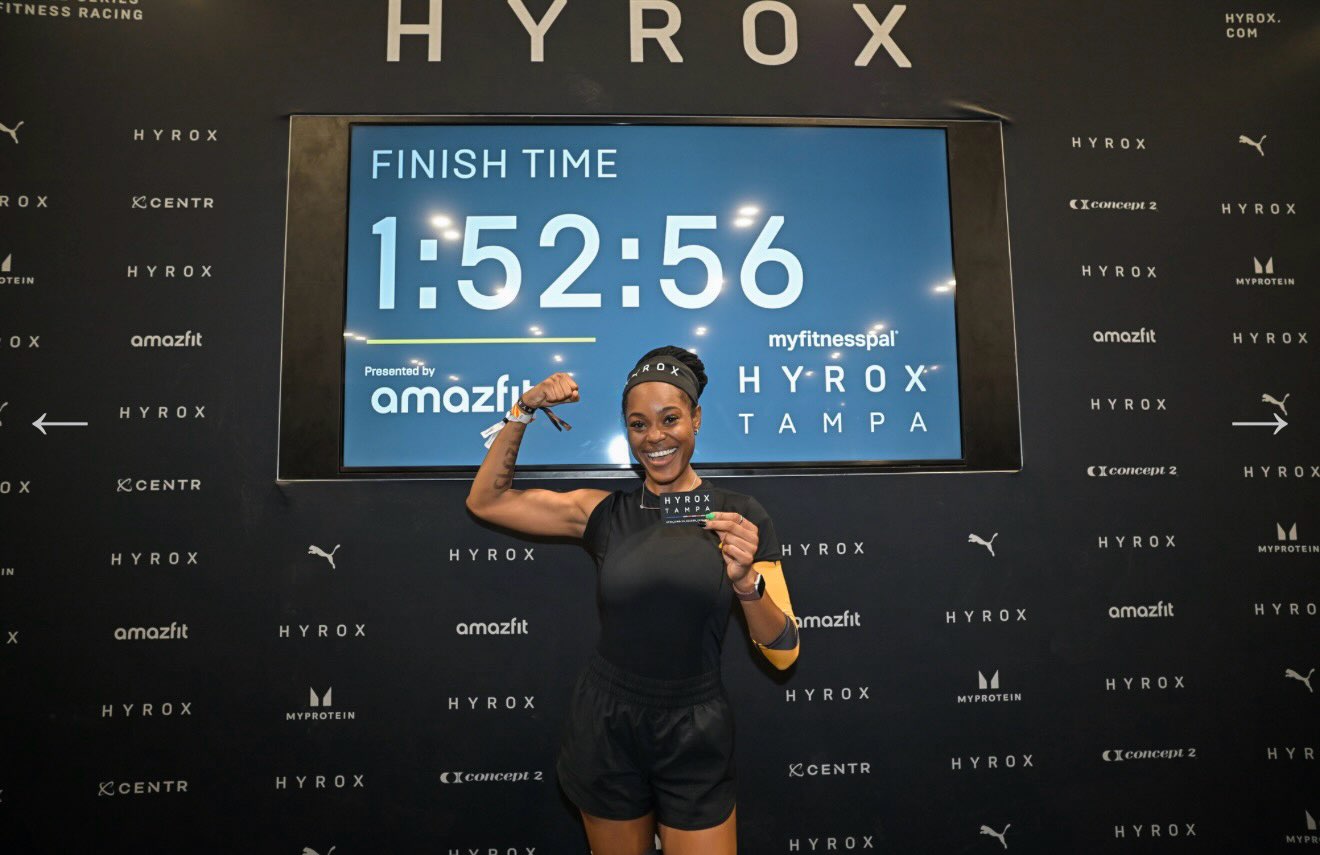
There is a photograph Jezeel Bryan posted after her race in late October that says most of it before she says a word. She is standing under a giant finish screen at HYROX Tampa, medal in hand, one arm flexed, grinning like the course owed her an apology. The screen above her reads 1:52:56, a personal best, set in her home city, five months after her first HYROX Singles tested everything she had. What the photograph cannot show you is the starting line she actually came from: a young woman from Jamaica who arrived at Army Basic Training unable to run a single mile without stopping.
Jezeel Bryan is a proud Jamaican native who has called Tampa home for nearly a decade. She is still in her twenties, and she is carrying a lot of titles at once: digital creator, hybrid athlete, wellness advocate, business owner, and a soldier in her fifth year with the U.S. Army National Guard, where she serves as an Automated Logistical Specialist. More than 66,000 people follow her main page, @jez_876, for a mix that is entirely her own: Jamaican food and family, cultural comedy, serious training, and hair. But the titles are not the story. The story is how a woman who was once teased for her body, who once could not finish a mile, rebuilt herself into someone who now races, marches and builds for a living, and decided to bring other women with her.
Her platform began during the COVID-19 pandemic, when she started sharing traditional Jamaican herbal remedies online. What began as a way to stay connected to her culture grew into a creative platform that resonated across the diaspora. Coming to the United States as an immigrant, navigating mental health struggles and rebuilding her life in a new country taught her, in her own words, the importance of perseverance, community and self-belief. It also taught her gratitude. “I have learned to be grateful, resourceful and resilient while valuing every opportunity that comes my way,” she told Jamroc Nation. “I have also gained a strong desire to honor my roots and be an inspiration for others to express themselves.”
The mile she could not run
Fitness was not always hers. It became part of her identity at 21, when she joined the military while managing PCOS, a hormonal and metabolic condition whose symptoms often affected her daily life. When she arrived at Basic Training, she could not run a mile without stopping or lift her own body weight, and she reckons she may have been one of the least athletic women there. The military pushed her past what she thought were her limits, and slowly, fitness stopped being a routine and became a way to manage her symptoms, improve her well-being and take back a sense of control.
There is an older wound underneath that story, and she does not hide it. Growing up in Jamaica, she was often criticized for being “mawga,” the Jamaican word for being very thin. She internalized those comments as a child, and they followed her into body dysmorphia during her teenage years. Confidence did not come from a mirror. It came from proof. “I did not truly begin to feel confident in my body until it showed me what it could do,” she said. Her body carried her through a 10-mile ruck march with a rifle and a 30-pound rucksack on her back. It carried her through races and distances she once could not have imagined. She learned to value her body for its strength, resilience and capability, not simply for how it looks. That sentence is the whole feature, really. Everything else she does is built on it.
A hybrid athlete, by definition and by week
These days she calls herself a hybrid athlete, and she means it as a training philosophy, not a label. It means training for strength, endurance, mobility and overall performance at the same time, supported by intentional nutrition, rest and recovery. She trains five days a week, sometimes six. She prepares her meals daily. She syncs her training to her menstrual cycle, adjusting intensity to her energy and symptoms instead of forcing her body to perform the same way every day. Rest, in her world, is part of progress, not a break from it.
The proof is in the record she has stacked up: a 15K race, five 10K races, two virtual marathons, two HYROX Singles competitions and a string of other endurance events, all from the woman who once stopped inside a single mile.

Her second HYROX Singles, held in Tampa in late October, is the one she keeps returning to. She was nervous, because the first one had felt so difficult. She was also honored to be standing at that start line just five months later, in her home city, and confident she would finish with a personal best. What carried her through the race was faith. “Throughout the race I felt fear, excitement, confusion, pain and adrenaline all at once,” she said. “Internally, I was asking God to get me through the next lap, thanking Him for the extra energy during a difficult station, and looking for reminders that He was always with me.” What hurt most was not a station or a lap. It was not having the people she loves there to witness it firsthand. By the finish line, she was relieved, and proud. “Proving to myself that I could do it, and do it better, made me proud of how much stronger I had become in just five months,” she said. “Crossing that finish line reminded me that none of that work was wasted.”
What 18.6 miles teaches you
If HYROX is her test of speed and strength, the Norwegian Ruck March is her test of something quieter. She completed the 18.6-mile march carrying 28 pounds of dry weight, and what it taught her was not about fitness at all. The distance is physically demanding, she says, but the bigger challenge is staying mentally present when your body is tired, your feet hurt and the finish line still feels far away. Her method is simple enough to borrow for almost anything hard: break it into smaller goals. Just make it to the next mile. The next checkpoint. The next step. “Strength isn’t always about moving quickly,” she said. “Sometimes it’s about continuing with purpose when progress feels slow.” The march showed her that discipline can carry a person through the moments when motivation disappears, and that she is stronger and more resilient than she gives herself credit for.

That discipline has a uniform behind it. The Army National Guard taught her that you do not only train when you feel motivated. You show up, you follow through, and you give your best effort regardless of the circumstances. She respects preparation, stays focused when things get uncomfortable, and trusts that small, consistent efforts build the strength needed for the biggest challenges. It is the same standard whether the task is a workout, a ruck march or a race.
The builder: Locs by Jez
Away from the course, she builds. Locs by Jez, her Tampa loc studio and community at @locsbyjez, was never meant to be just a service. “Building Locs by Jez came from wanting to create more than a service. It was about creating a community,” she said. “I wanted people to feel seen, cared for, and confident in embracing their natural hair.” Her own locs are deeply personal to her: they represent patience, growth, identity and freedom, a visible reminder that beauty does not have to fit one standard, and that something meaningful can develop over time with proper care. Anyone who has watched her train knows the same patience runs through everything. Locs, like endurance, are a long game played in public.

Her wellness message refuses to split her life into pieces. The gym, the kitchen and Carnival all belong in it. Jamaican food is special to her because she grew up with her grandparents and her mother cooking every day, and in her family, love was expressed through food: the time, care and intention behind every meal brought them together and connected her to her roots. So wellness, for her, is not about giving up the foods and traditions she loves. It is about balance, nourishment and movement, enjoyed on purpose. The gym represents discipline. The kitchen represents family and nourishment. Carnival represents celebration, community and freedom. Together, she says, they show that wellness can support the whole person: body, mind and spirit.
And she has a direct word for Jamaican and Caribbean women who feel fitness spaces were not built for them. “You belong there,” she said. Fitness spaces have not always reflected or welcomed Caribbean women, but that is no reason to shrink or wait for permission to take up space. Start where it feels comfortable, walking, dancing, strength training, or inside a supportive community. Fitness does not have to mean changing who you are. It can be a way of honoring your body, building confidence and becoming stronger. Her closing argument is simple: you deserve to feel powerful, comfortable and celebrated in every space you enter.
The Jamroc chapter
Her connection to Jamroc Dept. started the way most of her story starts, through a shared love of Jamaican culture, community and storytelling. She said yes to being an ambassador because, to her, the brand represents more than clothing. It celebrates roots, and it encourages people to carry their identity with pride. Jamroc’s line is “Carry the story forward,” and when she is asked what story she is carrying when she trains and competes, her answer comes quickly: “the story of resilience, discipline and love that was passed down to me.” She is carrying her family, her Jamaican heritage and the generations before her who worked hard and created opportunities. “Every workout and competition is a reminder that I’m not moving forward alone,” she said. “I’m carrying the story forward for the people who came before me and those who will come after.”

What comes next
The next twelve months, in her telling, are a season of transition. More races, new challenges, and travel through sport. More building at Locs by Jez, and more ways to serve and connect with her community. And the close of a chapter: she is in her final year in the Army National Guard, grateful for everything it taught her, and clear-eyed about what comes next in racing, in business and in life.
If a young woman in Jamaica or anywhere in the diaspora reads this and wants to start, Jezeel Bryan’s first instruction is to begin before she feels fully ready. You do not need perfect equipment, experience or permission. Start small, stay consistent, and find a community that supports and encourages you. Do not change who you are to fit into a space, because your culture, your story and your identity belong in every room you enter. Be patient with yourself, celebrate your progress, and hold on to her final reminder, the one her whole story keeps proving: “Your starting point does not determine how far you can go.” Her longer list is worth taking whole: learn to love yourself, go to therapy, let your life be your own, start over as many times as you need to, educate yourself, take risks, and dare greatly.
A few years ago, she could not run a mile. This fall, she flexed under a personal best on a screen in her home city, with an 18.6-mile march and two HYROX finishes behind her, building a community one head of locs and one hard workout at a time. The distance between those two women is not talent. It is discipline, patience and roots, carried forward one step at a time. Her story, by her own design, is still being written.
Find Jezeel Bryan at @jez_876, her training at @jez_active, and Locs by Jez at @locsbyjez.
Leave a Reply