
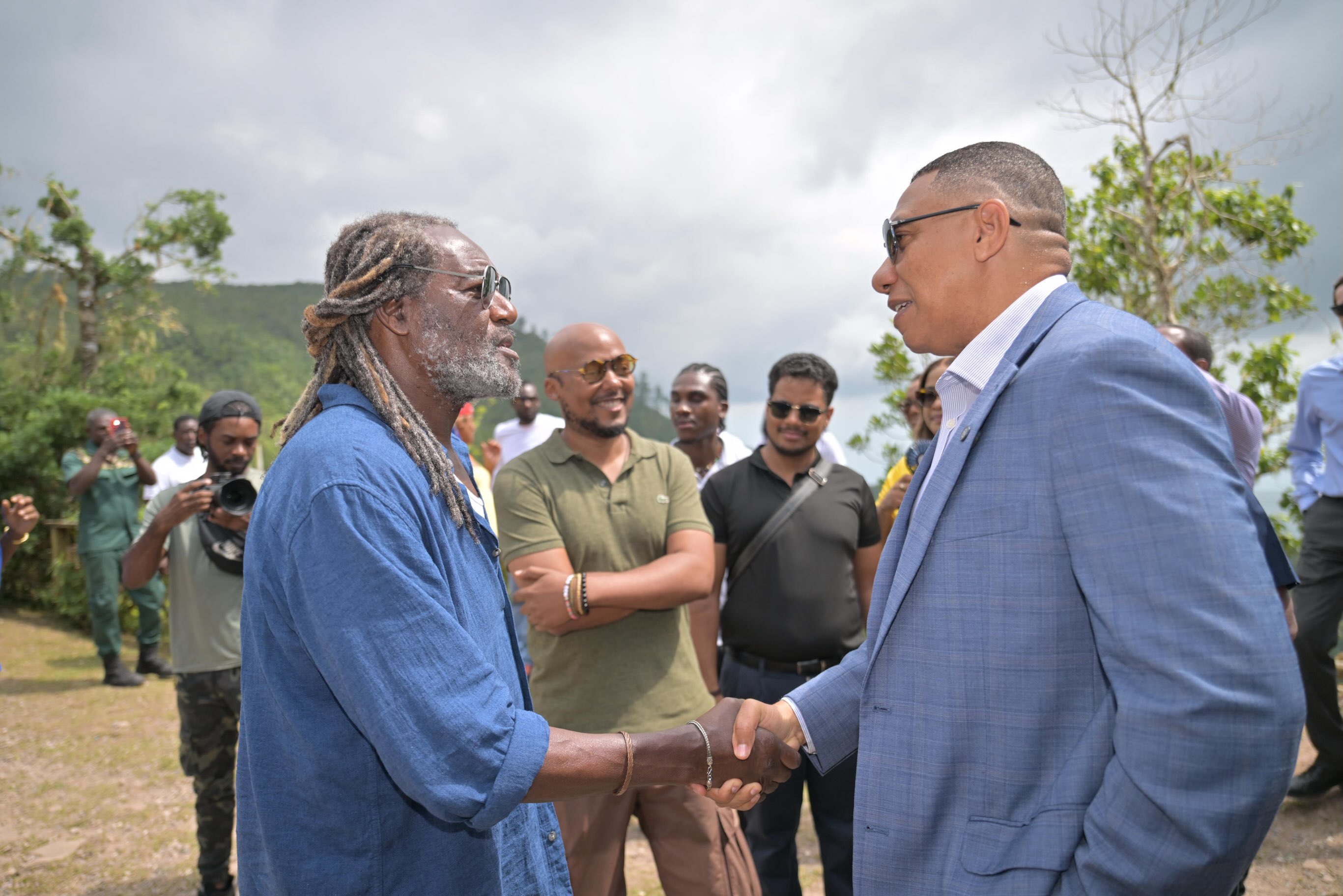
On a September morning in the Blue Mountains, the Prime Minister of Jamaica walked a trail at Holywell to shake hands with a film crew.
Andrew Holness was not the biggest name on that set. That belonged to Delroy Lindo, the Oscar nominated actor born in London to Jamaican parents from Ocho Rios, who was in the mountains directing his first feature, Jabari’s People, a story he had been carrying for more than a decade. Lindo first encountered the script in 2015. He acquired the rights in 2021 and tried to get it made, and the project stalled, the way so many Caribbean stories stall. This year it finally happened: a 22 day shoot, a cast led by Winston Duke, Marianne Jean-Baptiste and Wendell Pierce, and a company of Jamaican actors Lindo praised by name in the press. “None of them have let me down,” he said of his local cast.
The Prime Minister’s visit produced the photograph the government wanted: Jamaica’s leader, on a Jamaican set, beside a Jamaican story the world will see. It is a genuinely good picture. It is also only half of the one the industry is living in.
Because the other picture looks like this. According to figures from the Planning Institute of Jamaica, production spend in 2025 fell by 54 percent, down to about US$4.91 million after Hurricane Melissa. Temporary production jobs fell from 1,637 to roughly 1,000. In the same season that Jamaica’s film industry is collecting its biggest names, its largest public fund and its first regional cinema breakthrough, the official count of the industry shrank by half.
Both stories are true at once. The argument consuming the culture right now is about what that means.
A Story That Took Ten Years to Come Home

Start with the film itself, because Jabari’s People is the argument in miniature.
The screenplay, by Daoud Abeid and Dakhil Hausif, follows a headstrong Brooklyn teenager sent to live with his estranged grandparents in the Blue Mountains after his mother’s death. Lindo plays the stern grandfather. Jean-Baptiste plays the grandmother. Duke plays the boy’s overburdened father. It is a story about grief, heritage and the distance between the Jamaica people leave and the Jamaica that raises their children. It is, in other words, the diaspora’s own story, and Lindo has been blunt about where it had to be told. “This can only be made in Jamaica because it’s a Jamaican story,” he said.
The production was mounted under the film co-production treaty between the United Kingdom and Jamaica, an agreement that has existed for 20 years and, remarkably, had never been used. Read that again. For two decades, a legal bridge between Jamaican stories and British financing sat on the shelf, and it took a son of Ocho Rios, arriving with Hollywood weight behind him, to walk across it first.
The shoot employed Jamaicans in front of the camera and behind it, spent its money in the island’s hills and towns, and applied for support from the government’s new screen fund. By every measure the industry says it wants, this is the model production. And yet its very existence raises the question its makers would probably endorse: why did it take this long, and why did it take him?
The Director From Negril

If Jabari’s People is the visiting production done right, Possession is the other half of the dream: a Jamaican in the director’s chair of a full international series.
Storm Saulter, from Negril, built his name on films like Better Mus’ Come and Sprinter. This year he directed Possession, a five part supernatural thriller made for Sky Studios, written by Karla Crome from an original story by Jefferson Bannis. Gugu Mbatha-Raw plays Claudia, a Bristol lawyer sent to Jamaica to fight an inheritance claim tied to an old plantation, and the series braids legal drama with Jamaican folklore, colonial history and the spiritual world the island actually believes in.
What Saulter refused to do matters as much as what he did. The dialogue stays in authentic Jamaican patois. Real Junkanoo performers appear on screen. Nine Night musicians play. A cultural adviser, Dr. L’Antoinette Stines, worked with the production, and filming sites received ancestral blessings. Jamaican actors, Sheldon Shepherd, Nadean Rawlins and Shantol Jackson among them, stand in the frame beside Mbatha-Raw and Jonny Lee Miller, not behind them. More than 140 Jamaican crew members built the world.
Saulter is the first Jamaican resident filmmaker to direct an international series of this kind. The show premiered in Britain in August and rolled out across the Caribbean and Latin America this autumn to serious acclaim. A Jamaican director’s name sits on a global series, and the culture it portrays is not decoration. It is the subject.
Hold that achievement in one hand. In the other, hold this: the series’ release in the United States is still pending. When the show’s Caribbean launch was announced, the comment threads filled with the same question from Jamaicans abroad and Americans alike. Where can I watch this? The biggest Jamaican directed series in history is streaming in Latin America before the largest Jamaican diaspora market on earth can legally see it. That is not a footnote to the industry’s story. In many ways, it is the story.
The Billion, and What Has Already Moved

The government’s answer to decades of underinvestment is the Jamaica Screen Development Initiative, a J$1 billion fund launched in 2024 to finance local screen projects through development, production and completion.
The fund is not only a promise. In July, the Prime Minister told an audience at the University of Technology that $668 million had already been approved for local film productions, set to benefit 91 micro, small and medium sized enterprises. Productions like Jabari’s People have applied into the same system. Kingston’s LAB Studios, meanwhile, is doing the unglamorous work of building a slate, project after project, the way an industry is actually built.
So the money exists, some of it is moving, and a local infrastructure is visibly forming. And yet walk into any room where working Jamaican filmmakers talk honestly, and the skepticism is not hard to find. It is not aimed at the size of the number. It is aimed at the distance between the number and the ground.
The Numbers Nobody Can Spin

The Planning Institute’s figures deserve to be sat with, because they describe the industry as it is, not as anyone wishes it to be.
US$4.91 million in production spend for an entire year. Roughly 1,000 temporary production jobs, down from 1,637. A 54 percent fall in twelve months.
The hurricane is the first explanation, and it is a fair one. Melissa devastated western Jamaica, and film production is the most footloose business in the world. A production does not have to endure hard conditions. It can shoot the same sunshine in another country next month, and some productions quietly did.
But notice what the fairness of that explanation reveals. An industry that loses half its measured activity to one storm is an industry whose activity mostly belongs to visitors. Local productions do not leave when times get hard. They cannot. They live here. The drop is so steep precisely because so much of what gets counted as the Jamaican film industry is not, in ownership terms, Jamaican at all.
The optimists answer that every serious film nation started exactly here, renting its landscape and its labour to the world while it built the capacity to tell its own stories at scale, and that the dip says more about the old model ending than the new one failing. The pessimists answer that they have heard versions of that speech for thirty years. Both are working from the same numbers. Neither is lying.
Argument One: An Industry, or Just a Location?
Underneath everything sits the oldest question in Jamaican film: is the island building an industry, or is it a beautiful location with a skilled workforce for hire?
The case for the location model is not weak. Visiting productions bring money the local economy does not have to raise. They hire crews at international rates, fill hotels and restaurants, rent vehicles and equipment, and train Jamaican technicians on budgets no local producer can currently match. Saulter’s 140 crew members on Possession did not just earn a wage. They came away with credits and skills that raise the ceiling for every local production that follows.
The case against is about where the value ends up. A visiting production arrives with its financing raised, its stars attached, its distribution sold and its profits spoken for. Jamaica supplies the ground, the faces and the hands, and when the shoot wraps, the asset leaves on a hard drive. The film may be set in Jamaica, shot in Jamaica and loved in Jamaica, and Jamaica may still own none of it.
What has changed the temperature of this argument is who is now making it. The Prime Minister himself has taken to saying it in public: the goal is Jamaican stories, Jamaican financing and Jamaican profits. When the head of government starts voicing the location critique from a film set, the debate is no longer between the industry and the state. It is inside both of them.
Argument Two: Who Does the Billion Reach?
Ask a room of Jamaican filmmakers about the J$1 billion and you will get the same two reactions, often from the same person, in the same breath.
The first is real pride. Generations of Jamaican directors financed films from their own pockets, from family abroad, from favours and credit. For the state to finally put a billion dollar figure behind the sector is a form of recognition the culture has demanded for decades, and nobody serious dismisses it.
The second reaction is a practical question that has not yet been publicly answered to the industry’s satisfaction: how does a filmmaker with no connections, no track record at that scale and no producer’s polish actually get through the door? The approvals announced so far, $668 million across 91 enterprises, show the machinery turning. What they do not yet show is the shape of the turn: which stages of production, which parishes, which budget sizes, how many first time feature directors.
The skepticism reaches down to the smallest frictions of the working filmmaker’s day. In the public conversation around the fund, filmmakers have raised the everyday machinery of production, the permits, the clearances, even the process for something as basic as using a prop weapon in a scene, and asked whether any of that gets easier for the small production shooting in a community on a weekend. It sounds like a minor point until you have tried to make a film on favours. Productions do not die from one big obstacle. They die from fifty small ones.
The honest position, for now, is that the fund is real and its reach is unproven. Those two facts will be tested by the first full cycle of projects it produces, and the entire industry knows it is the test that matters.

Argument Three: The Camera in the Suitcase
There is a smaller, sharper argument that filmmakers return to again and again, because it can be explained in one scene.
A foreign production flies into Jamaica with cases of professional equipment. The gear is admitted for the production’s use and, when the shoot ends, it flies back out, duty free, as temporary imports do in film industries all over the world. Nobody in the local industry begrudges the arrangement. It is part of the price of competing for productions.
Now picture the Jamaican cinematographer who has saved for two years to buy a professional camera of her own, to stop renting, to own the tool her whole business depends on. She imports the same class of equipment, permanently, to build permanent capacity in the industry her country says it wants. She pays high duties on it.
The visiting production’s camera is treated as an instrument of the industry. The local filmmaker’s camera is treated as a purchase. Defenders of the current system point out, correctly, that duty treatment for temporary imports is standard international practice, and that Jamaica cannot unilaterally make itself more expensive for visiting productions without losing them. The filmmakers’ reply is not a demand to tax the visitors. It is a question: why can the same relief not follow the local who is building the thing the visitors are celebrated for using?
Of all the arguments in this piece, this is the one with a price tag attached to both sides, which may be why it refuses to go away.
Argument Four: The Film Nobody Can Watch

And then there is the argument that begins where every film’s life is supposed to start: with an audience.
Consider Stew Peas. Sosiessia Nixon-Kelly wrote, directed and produced the psychological thriller as her first feature, after more than ten shorts, and shot it entirely in Kingston. Chiney K, Kerry-Ann Collins, plays a detective investigating her best friend’s murder while a housekeeper with a secret works on her marriage from inside the house. The film premiered at Carib 5 in Kingston in June, opened across Jamaica in July, and then did something Jamaican films almost never do: it stayed. It held Jamaican screens for nearly three months.
In October it crossed the water. Stew Peas opened simultaneously in seven territories, Antigua, Barbados, Guyana, St. Lucia, St. Kitts, Trinidad and Tobago and the US Virgin Islands, through Caribbean Cinemas, becoming the first Jamaican film the regional chain has ever distributed. It collected six nominations at the inaugural Caribbean Film Awards, including Best Director and Best Actress, and a limited release in the United States follows in January.
By any measure, that is a triumph. But sit with what it reveals. A Jamaican feature reaching Caribbean cinemas is historic because it had never happened. The normal fate of a Jamaican film, even a decorated one, is a premiere, a short local run if fortune allows, a festival screening or two abroad, and then a long twilight in which the people whose story it is cannot legally watch it anywhere. No shelf was ever built for these films at scale, so they live in laptops, links and memory.
Possession’s missing American release tells the same story from the top of the market. Distribution is the wall at every level of the industry, for the first time feature shot in Kingston and the global series directed from Negril alike. Funding announcements lead the speeches. But filmmakers who have finished a film and then carried it from door to door looking for an audience will tell you the speeches are in the wrong order. A film nobody can watch builds no audience, no returns and no next film, however it was financed.

Argument Five: So Is the Boom Real?
Put the year on one page. A story carried for a decade by a son of the soil comes home to the Blue Mountains and wraps, with the Prime Minister on set. A director from Negril delivers a global series that treats Jamaican spirituality as a subject, not a backdrop, and becomes the first resident filmmaker to do it. The largest screen fund in the country’s history opens its door and starts approving money. A Kingston thriller becomes the first Jamaican film a regional cinema chain has ever carried. And the official count of the industry falls by half.
One reading says this is precisely what a turning point looks like from inside it: the visiting production economy shrinking under a storm and a shifting world, the owned economy still too young to register in the totals, and a gap between the two that feels like decline and is actually transition. The other reading says Jamaica has been photographed at turning points before, has applauded funds and firsts before, and has learned to ask for the receipts: the ownership, the access, the audience.
There is no honest verdict on offer yet, and anyone selling one is selling something. What the record does support is narrower and stronger. The directors are here, in Negril and Kingston and the hills above both. The crews are deep and getting deeper. The treaty that slept for 20 years has been used. The chain that never carried a Jamaican film has carried one. The fund, whatever its reach proves to be, exists.
Jamaica has the talent. So what is really holding the industry back?
Leave a Reply