
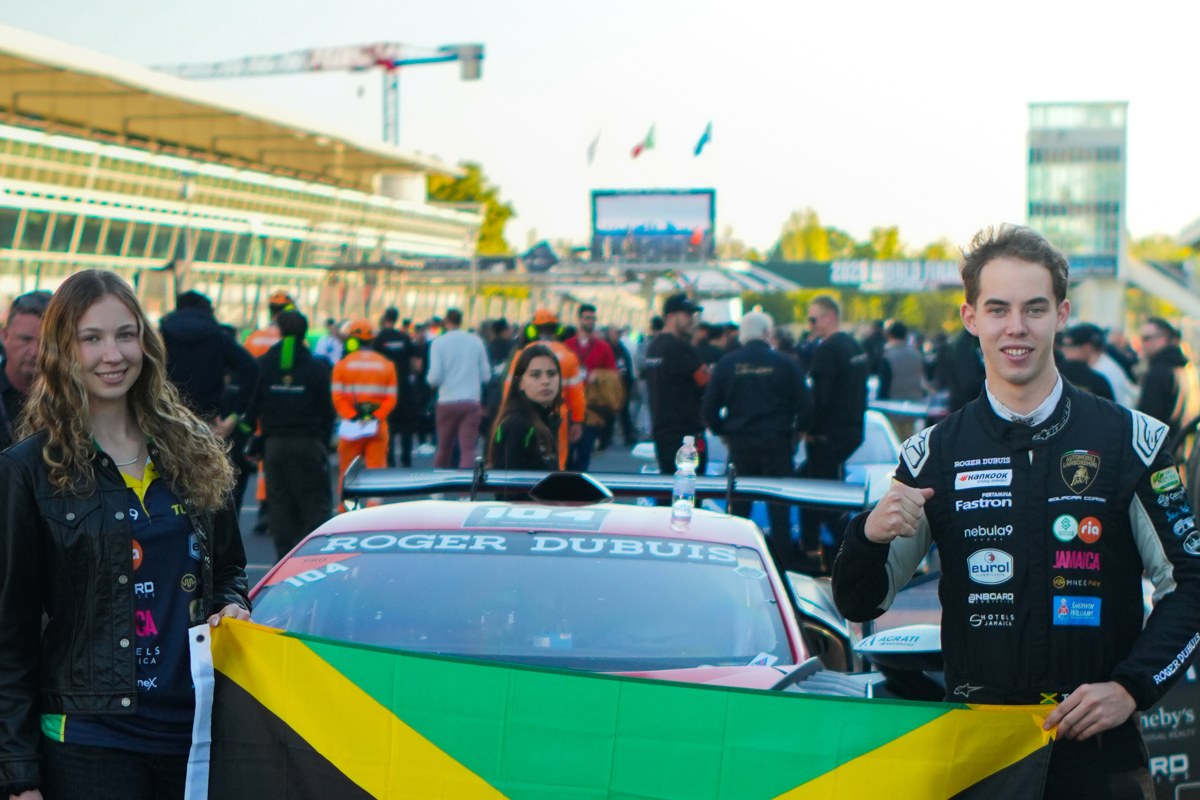
Somewhere in a paddock in Florida, or Germany, or Italy, surrounded by teams with bigger budgets and longer histories, Tommi Gore makes sure the Jamaican flag is exactly where it belongs: on his car, on his helmet, and close enough to reach.
“I bring the Jamaican flag to every grid I line up on,” he told Jamroc Nation. “In the paddock I’m usually the only Caribbean driver, and I carry that with pride.”
That is not a slogan bought from a marketing team. It is the whole strategy of a career that, by every rule of motorsport economics, was not supposed to happen. There is no ladder of funded academies waiting for a talented kid from Montego Bay. Gore’s ladder had to be built by his family, rung by rung, across three generations.
Built, Not Given
Gore grew up between Montego Bay and Kingston, and he counts the upbringing itself as training.
“Growing up in Jamaica teaches you to work and to hustle,” he said. “Nothing gets handed to you, so you learn to make things happen with what you have. That’s how I approach racing. Jamaica isn’t a motorsport nation like Germany or the US, so every step forward had to be built.”
Racing is the family trade. His grandfather Neil raced at the old Vernamfield circuit. His father, Doug “Hollywood” Gore, became one of Jamaica’s best known drivers, a double Caribbean Motor Racing Champion and a fixture at Dover Raceway. His uncle Matthew raced at the front of the Jamaican grid alongside them.
“My father, Doug Gore, taught me to play hard you have to work harder,” he said. “That’s how our family business and racing careers have lasted over 30 years.”
He started in karts at Palisadoes in Kingston at five years old, and one memory settled everything: “The first time I drove at Palisadoes, from then on I wasn’t interested in anything that didn’t go fast.”
The results followed the obsession. He became a three time Jamaican Rotax Junior champion, collected FIA Americas junior honours twice, and in 2019, at 14, became the youngest driver ever to race a car at Dover Raceway. By 2022 he was a national champion in Jamaica’s Modified Production 2 class, the same year his father won his own class title. The family business, in every sense, was still winning.
Two Jamaicans on a German Podium
Europe was the test. In 2024 Gore stepped into ADAC GT4 Germany, one of the most competitive GT4 championships in the world, sharing a car with fellow Jamaican Senna Summerbell. The pairing carried its own poetry: Summerbell’s father, David, was Doug Gore’s great rival, and the sons of two Jamaican racing dynasties went to Germany as teammates.
They changed teams and cars mid season, from an Audi to a Porsche, and at the Hockenheim finale they finished third, two Jamaicans standing on a German podium. Gore calls it the moment that changed everything.
“Standing on the podium in the ADAC GT4 Germany Championship in 2024 with another Jamaican, Senna Summerbell,” he said. “That’s one of the most competitive GT4 series in the world, and a Jamaican was on the podium. It proved to me, and to the people watching back home, that we belong at that level.”
The season after was the hardest of his life, and he does not dress it up. A new team mate, Alon Gabbay, a new car, no familiar faces. “Definitely 2025,” he said, when asked for his hardest season. “I had to learn to adapt to my surroundings and make my environment work for me. It was a tricky season finding back my pace.”
He found it. According to ADAC’s own race reports, Gore charged from 13th on the grid to third at the Sachsenring, then took back to back second place finishes at the Red Bull Ring. He closed the year eighth overall in the championship, and his team, AVIA W&S Motorsport, took the team title. In his words: “We ended on a high with a front row start and 3 consecutive podium finishes.”

The Lamborghini Call
For 2026, Gore crossed the Atlantic into Lamborghini Super Trofeo North America, the IMSA sanctioned one make series where every driver races the same Huracán Super Trofeo EVO2 and the only difference is the people. He signed with ANSA Motorsports, in the No. 4 car, in the Pro class, the deepest end of the field. He was, according to ANSA Motorsports, the first Jamaican ever to race in Lamborghini Super Trofeo.
The season started like a statement: a podium at Sebring in only his second race in the car, then two more at Laguna Seca, three podiums in his first four starts. In July, Lamborghini Squadra Corse made it official, naming him to its 2026 Young Driver Programs as a Super Trofeo Junior Driver, under the factory’s eye.
The finale took the season to Monza in Italy, Lamborghini home ground, where the World Finals put the best Super Trofeo drivers from three continents on one grid. Gore’s car carried the number 104 and one word across its rear wing: JAMAICA.
Then, weeks before the biggest weekend of his career, the money nearly ran out.
“Prior to the final round of the Lamborghini Super Trofeo Championship in Monza for the World Finals, we were short of budget to make the final round,” he said. “My first thought was that I’d come too far to stop. What I did next was pick up the phone. We called everyone who has been involved along the way and got the funding together to make the last event happen.”
It paid off. Per IMSA’s official World Finals report, Gore and co driver Colin Queen brought the No. 104 home fourth in the second World Finals race, and fifth overall in the Pro World Finals standings. His final championship line for the season, per IMSA’s points: sixth in Pro, 73 points, three podiums, in his first year in the car.
“P5 in the World Finals is no small feat,” he said. The money was not there, the calls got made, and the flag still lined up on the grid.

The Double Life
Here is what separates Gore from most young drivers: on Monday morning, the racing stops and the work changes shape, but it never really stops.
“No two days are the same,” he said. “A typical day is calls with my freight and customs teams, sourcing parts and logistics for the race team, fitness and sim training, and university work. I’m completing a double major in International Business and Supply Chain Management at FIU. On race weeks everything shifts to the car, the engineers and the data.”
Off the track, he runs a group of Jamaican businesses in freight, customs brokerage, automotive service and media, the same family enterprise his father built, the same enterprise that has quietly bankrolled Jamaican racing for three decades. The business is not a distraction from the racing. In Gore’s world, the business is what makes the racing possible.
It also explains the part of his craft fans never see. “The hours on the simulator learning tracks before I ever arrive, the fitness work to handle the heat and G-forces in a GT car, and the data debriefs after every session,” he said. “Fans see an hour of racing. Behind that are weeks of preparation, plus the logistics of getting a car, a crew and parts to another country.”
“Success taught me that it’s never just you,” he said. “Every result comes from engineers, mechanics, sponsors and family. Failure taught me more. I’d rather lose and learn than win and coast.”

Building the Road Behind Him
The part of the story Gore seems proudest of is the part that is not about him. Between his American rounds in 2026, he raced at home in the region, winning in Guyana with his Caribbean backers at Team One Guyana and setting a GT3 lap record at the South Dakota Circuit in July, per the Guyana Motor Racing and Sports Club’s official records.
More importantly, he has taken a seat at the table where Caribbean motorsport gets governed. In February 2026 he was elected a director of the Jamaica Millennium Motoring Club, the national governing body, and according to Sportscar365 he was completing race director training while racing at Monza. He is working with the JMMC on GT regulations for the region.
“It matters because I want a real pathway for Caribbean drivers,” he said, “so the next one doesn’t have to build everything from scratch like I did.”
His advice to that next one is pure Gore. “Start now with what you have. Karting and sim racing are real training. Learn the business side early, because talent alone doesn’t get you on the grid; sponsors and relationships do. Be professional before anybody is paying you to be.”
Ask him where he is in life right now, in one word, and he does not pause: “Accelerating.” Ask him what he wants to be remembered for and the answer is just as short: “My impact.”
But the line that explains the whole career is the one he gave when asked how he wants people to feel after they watch him work.
“I want them to feel that it’s possible,” he said. “When a kid in Jamaica sees a Jamaican flag on a GT3 car in Europe, I want them to think, ‘I can do that too.’”
Somewhere between Montego Bay and Monza, that kid is already watching.
And his song that feels like home, for the record: “Trophies” by Masicka. Of course it is.
Leave a Reply